The Ultimate Danube Bend Itinerary: Historical Travels in Hungary by Car
Arriving in Budapest, we can take a short two-day trip to discover the rich historical heritage of Hungary. We will embark on a journey through time. Now, we set off on a road trip, leaving Budapest towards the north on Main Road 11.
While still in Budapest, we can visit the remains of a city from ancient Rome. The Aquincum Museum uniquely presents the daily life of a once-flourishing city in ancient Pannonia. A unique piece in the museum is the famous ancient instrument, the water organ. Although debates still continue today regarding its actual operation, the reconstruction made using original metal components is nevertheless a unique monument to the diversity of antiquity. We should allocate an hour and a half to visit the museum. Detailed information can be found here.
Driving further north, we reach Szentendre. The historic core of the small town evokes the daily lives of the Serbian merchant families who once lived here. The center of the town offers a Mediterranean view. Szentendre is also called the town of painters, because many famous Hungarian painters lived and worked here. Without aiming for completeness, the collections of painters Béla Czóbel, Károly Kmetty, and ceramicist Margit Kovács can be seen. Visitors can find information about the Szentendre exhibition venues here. We could spend an entire day in Szentendre, but it is worth moving on towards Visegrád.
The most important monument of the former royal seat is the Citadel towering above the Danube. If we follow the sign for the “Panoráma út”, we can stop at a wonderful viewpoint to admire one of the most beautiful sections of the Danube Bend. An hour and a half to two hours is enough to visit the citadel, and details can be found, among others, on the website of the National Heritage Institute.
After visiting the castle, we enter Esztergom via the road running along the banks of the Danube. It is worth spending one night here, as the main attractions of the city will captivate our attention for an entire day. It is advisable to think about accommodation well in advance, because due to the city’s tourist traffic, it is not always possible to book immediately. Information about accommodation in Esztergom can be found here as well.
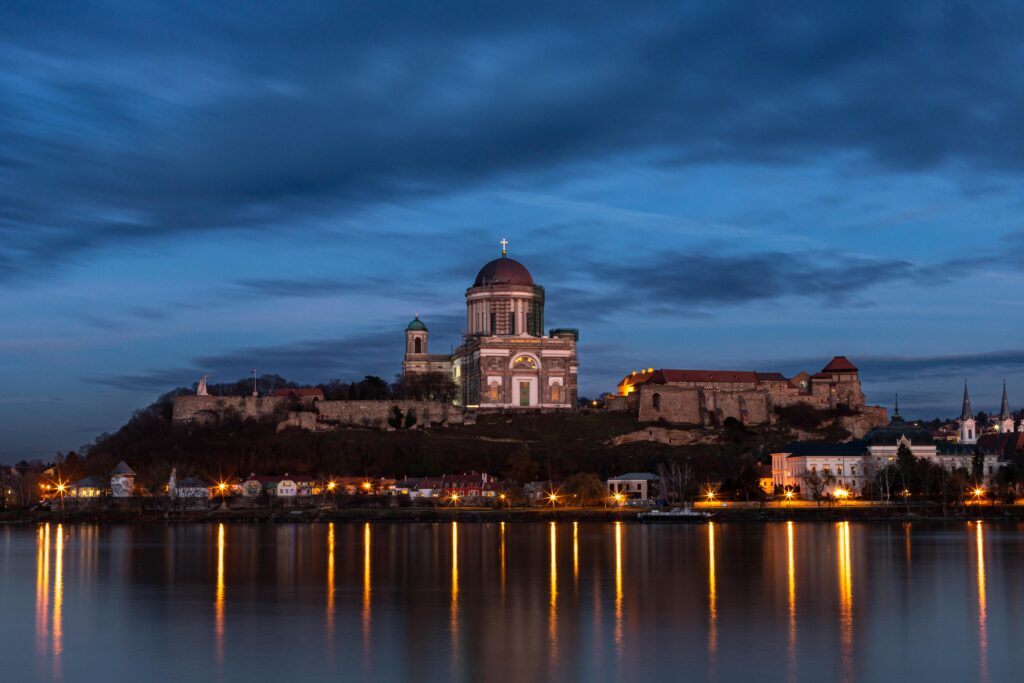
Upon arriving in the city, we are primarily greeted by the sight of the Esztergom Basilica. Esztergom is an archiepiscopal seat; the archbishopric was founded by King Saint Stephen in 1001. The dome of the Basilica functions as a lookout, offering a 180-degree view of the city and the Danube panorama.
The ecclesiastical treasury also operates within the Basilica, where valuable devotional objects, jewelry, and vestments can be viewed, providing a historical insight into the history of the Catholic Church.
It is worth visiting the Water Town (Víziváros), where we can admire the rare paintings and masterpieces of ecclesiastical sculpture in the Christian Museum.
The Danube Promenade is a pleasant place for a walk and relaxation in the city. We can walk across the Mária Valéria Bridge to Štúrovo in Slovakia, from where the panorama of Esztergom unfolds before us.
Great restaurants can be found in Esztergom, and it can be said that everyone will find a place that suits their style and preferences.
From Esztergom, we can drive further towards Bajna, passing through Dorog, a former mining town, where a mining exhibition can be viewed, featuring interesting details about the past of coal mining.
Bajna was already an inhabited settlement in the 11th century, but it became well-known as the hunting ground of the Count Sándor family living in Esztergom. The current Sándor-Metternich Castle was originally built here as a hunting lodge. Móric Sándor, the Devil Rider, notorious throughout Europe, began rebuilding the noble residence into a 59-room castle one year before his marriage to please his wife, Leontina Metternich. He commissioned József Hild, one of the most prominent architects of the era, with the transformation. The castle has undergone a full renovation and has become a prominent attraction in the area. Interestingly, the palace of Móric Sándor, the Sándor Palace in the Buda Castle, is currently the residence of the incumbent head of state of Hungary.
Finally, we drive towards Bicske to return to Budapest on the M1 motorway. The two-day road trip covered a distance of only 180 km, but during our journey, we were able to experience centuries of history.