Bluebeard’s Castle
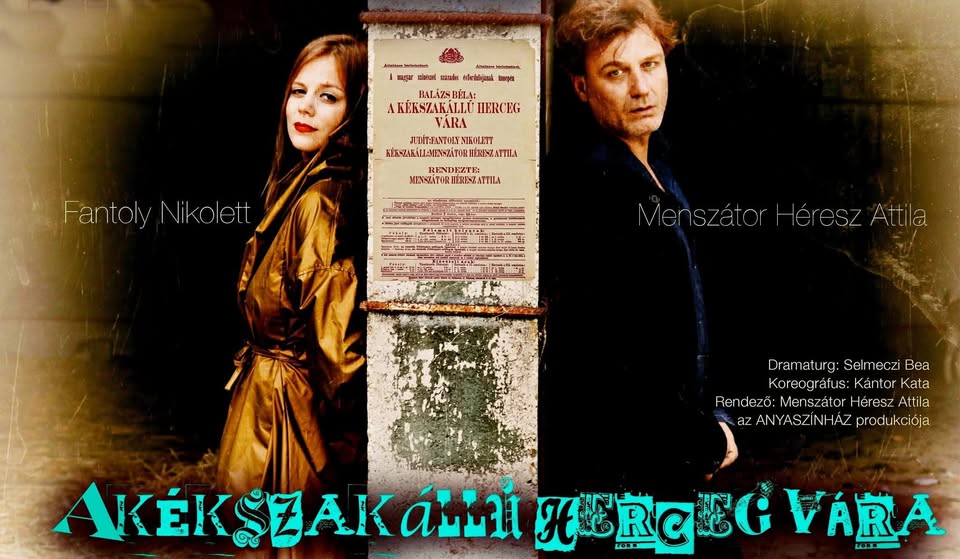
The opera Bluebeard’s Castle was put on the stage in a new interpretation by the RS9 Stage. Bluebeard’s Castle was composed by the Hungarian composer Béla Bartók as his only one-act opera in 1911, the premiere was in 1918 in the Budapest Opera House.
The libretto was written by Béla Balázs in 1910, based on an earlier, sixth-century Breton legend. In the original Breton legend, Count Canomor is there, but its historical precursor was processed many times already. For the beginning of the 1900s, the mood of loneliness and world-sorrow was typical not only in Hungary. At the time of the premiere on May 24, 1918, World War I, which started in 1914, was still going on. This also could put its stamp on the dark spirit of the age. The gloomy mood of the opera can therefore be understood as a print of an era.
The RS9 Theater is a small chamber theater in downtown Budapest, where they usually put on dramas, small-numbered but important pieces. Its interesting thing is that in the play, the actors, the artists play in the direct proximity of the audience, the viewer could even touch them, the distance-keeping typical for big theaters is not there, so practically we can enjoy every gesture of the actor.
We can see if sweat drops appear on their foreheads, we can see how their individual movements have what kind of effect on the stage play. Based on the story of Bluebeard’s Castle, the gloomy prince takes his new wife with him to his castle. The new wife, Judit is cheerful, chatty, and prepares for the reformation of the gloomy-mooded castle, she wants to take sunlight between those walls that maybe never saw it. Judit believes in the transforming power of love and her dynamism during the piece does not fade, it breaks only in the last scene. In the story, the prince shows his castle to Judit. This looks like a regular stage work, where the audience watches, and on the stage, the stage changes show the different rooms.
The new Bluebeard’s Castle changes this dramaturgy, and the viewers can follow the plot always going in different rooms, sometimes even moving on the castle stairs, the gloomy castle becomes a specifically real feeling.
In every room, another color waits for us, and the actors still stand one or two meters from us, we can watch such a play where the audience participates as an interactive viewer or even as a companion in the showing of the castle.
It is always hard to recommend such plays that tourists can also enjoy, because language differences many times separate the viewer from the play. This new processing of Bluebeard’s Castle, with the very lot of actor movement, very interestingly built stage sets, relatively little and short text, becomes completely understandable also for someone who is relying only on stresses, sets, and dance-like movements in understanding the plot.
In Bluebeard’s Castle, the gloomy mood is portrayed also by that among the sets, props, usually nothing is what it looks like. Totally everyday objects are grabbed by Judit, the new wife of Bluebeard, and it turns out that the most everyday object is also something completely else: a hat, a plate, a tube looking like a vacuum cleaner talks about something completely else, and every object has some kind of bad-omened behavior or such characteristic left from earlier times that we do not expect from it.
At the showing of the different rooms, the audience enjoying the play does not participate statically in the play, but is an important participant, because we can imagine ourselves even as the servants of Bluebeard, or as the lady-in-waiting of Judit. Or we can be knights who follow the showing of this bad-omened castle.
The actor movements are very important, they are built up very nicely and richly. Judit’s figure plays a central role all along. Practically, the piece consists of short texts, they are rather about Judit’s questions and Judit’s movements. The artist playing Judit lives in those spaces very effectively that are available to her. Since she stands close to the audience, practically every gesture of her is perfectly understandable, and directly absorbable. Unfortunately, the dramaturgy of the play in my opinion ends with a sad end: practically it turns out why Bluebeard always has a new wife. The totally new dramaturgy however completely transforms the structure of the original opera, makes it modern. At one point of the piece, it pays respect also before Béla Bartók with a short presentation of his career.
The RS9 Theater, the Astoria Theater Cultural Association was founded by Katalin Lábán and Dezső Dobay in 1990. The cultural institution operating since then too under the name RS9 Theater at number 9 Rumbach Sebestyén Street in the 7th district became known and recognized – also abroad –, because almost immediately after its foundation it reached international successes, even overseas: Poland, Scotland, Romania, USA, just to make mention of our guest performances, invitations at the level of country, continent. Beside their theater hall, in 2013 they opened their hall named RS9+ Vallai Garden on the other side of the street – at number 10 Rumbach S. Street. With this, their number of performances doubled.
Cast: Attila Menszátor Héresz, Nikolett Fantoly
Director: Attila Menszátor Héresz