Art Nouveau Walks in Budapest
By Viktor Szentkiralyi
Secession, Jugendstil, Art Nouveau, Stile Floreale, Tiffany styles expressions in different language areas but represent the same style which many characterize as the period of the end of the 19th century and the early primitive element of the 20th century.
One characteristic of the style trend is that it extended to all areas of life, everyday objects, paintings, sculptures and buildings also preserve its traces.
Many characteristically Secessionist buildings still found today in Budapest indicate that at the end of the 19th century, the city developed together with other capitals of Europe, Vienna, Paris.
A pleasant sunny morning is enough to discover the facades of Pest houses, specifically in the spirit of the Secession.
Let’s start the walk in Honvéd utca near Szabadság tér in the 5th district where the house number 3 is a characteristic representative of the European Art nouveau.
After a few minutes of walk, in Hold utca we can look at the building of the former Post Savings Bank, on top of which there are beehive and bull head motifs made of Zsolnay ceramics.
Let’s walk down to the Danube bank on Arany János utca, we can find Secessionist buildings in this street too, during the walk let’s look up and we will see wonderful facades.
Our next station is the Gresham Palace standing on Széchenyi tér, which is an elegant hotel today. Originally it was the palace of Count Kálmán Nákó, then a short-lived Viennese bank bought it, but it got its current name from the Gresham Insurance. The Gresham Insurance Company was once one of the largest insurance companies in the British Empire. It is an interesting fact that there are multiple significant buildings in Budapest linkable to former insurance companies, the Anker Palace or the New York Palace
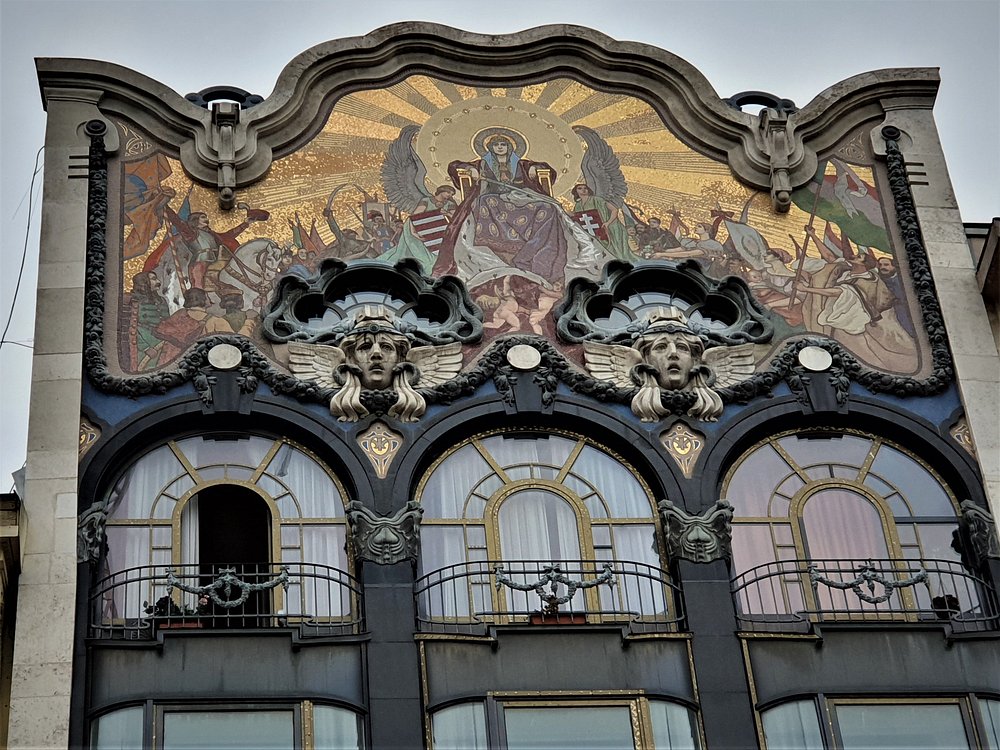
Let’s walk further on Bécsi utca and on Szervita tér we see the Török Bankház, on top of it a huge colorful glass mosaic decorates it, the Glorification of Hungaria.
Proceeding on Petőfi Sándor utca we reach Ferenciek tere, where the Párizsi Udvar, the building of the former Downtown Savings Bank and Insurance dominates its environment. Although the building was built in historicizing style it is worth viewing, today it operates as a luxury hotel.
During our journey there are multiple options to sit down on a terrace to have a coffee or taste the local specialties.
If we don’t feel like wandering alone then we can take advantage of one of the organized walks, where we can look at the sights of Budapest with an initiated guide. Here an option also opens up for the complete walkthrough of a building.
The team of Step by Step specialized specifically on the walkthrough of interior spaces and hidden villas. Among their current and regularly returning Secessionist programs such rarities are included like the Schiffer Villa next to the City Park giving home to the tax history museum or the monumental printer palace of the Palace District.
The Korzózz Velünk organizes interactive, storytelling walks, where they present the symbol system of the facades and the life of brilliant architects. for example in their program called Secessionist treasure hunt in Terézváros.
The Sétaműhely , beyond urban apartment buildings, also presents the rural and folk-inspired branch of Secession at a quite unique location in Wekerletelep, which is one of Central Europe’s unified worker residential areas designed also with the cooperation of Kós Károly.
If we talk about Secession then we cannot forget about one of its greatest figures, glass artist Miksa Róth, who was the dreamer and executioner of countless wonderful mosaics and glass windows still visible today, his works and life are presented by a museum, which is worth visiting.
Budapest awaits its visitors with countless interesting facts, attractive programs, and gastronomy, but if we live in the city, sometimes let’s try to behave like a tourist, move away from our usual routes, sit out to the Danube bank, climb up Gellért Hill and enjoy the city which we don’t even notice in the everyday rush.
Edited by the Hungary Now Team