Miskolctapolca – 50 Years Is a Long Time
Let us continue our journey through Hungary, this time using the 1977 edition of the Panoráma travel guide as our reference.
As I mentioned in one of my previous articles, the book is almost 900 pages long. Today, it is difficult to imagine how anyone could actually have used it as a practical handbook.
This time, our destination is Miskolctapolca. It is always interesting to come across places that have, over the years, been “swallowed up” by a city or another settlement. Miskolctapolca is one such place.
Miskolc is the centre of Northern Hungary. The city itself offers plenty of interesting sights, while its surroundings are also rich in attractions. The Castle of Diósgyőr, Lillafüred, Miskolctapolca and the hiking destinations of the Bükk Plateau are all worth visiting. The forest railway, built in 1920, can also be found here. Today it mainly operates on weekends and public holidays, offering a special experience for visitors.
In 1977, there was still no motorway connecting Budapest with Miskolc. Route 3 was a two-lane main road, with one lane in each direction, and covering the approximately 180-kilometre distance by car could take three to four hours. By express train, the journey took around 2 hours and 10 minutes. From Miskolc to Miskolctapolca, visitors could continue by local bus.
Miskolctapolca was not always part of Miskolc. It previously belonged to the village of Görömböly, under the name Görömbölytapolca. As towns and cities expanded, however, the resort gradually became part of Miskolc and is now one of the city’s districts.
The story of the Juno Hotel
In 1977, the travel guide listed the 108-room Juno Hotel among the accommodation options, along with several other hotels, private rooms and campsites.
The Juno Hotel closed in 2000, and the building, once considered modern, has remained empty ever since. In the early 2000s, the possibility of involving a financial investor was already being examined. Renovating and reopening a building of this size would require substantial capital, while the profitability of operating the hotel on a market basis would also be questionable. Demolishing the building, however, would likewise involve considerable costs.
The story of the Juno Hotel illustrates how difficult it can be to find a new future for a tourism investment that was once considered modern when the surrounding environment, visitor expectations and the economic conditions of operation have changed.
Today’s visitors can, however, choose from a range of smaller but high-quality accommodation options listed on various booking platforms.
The Cave Bath
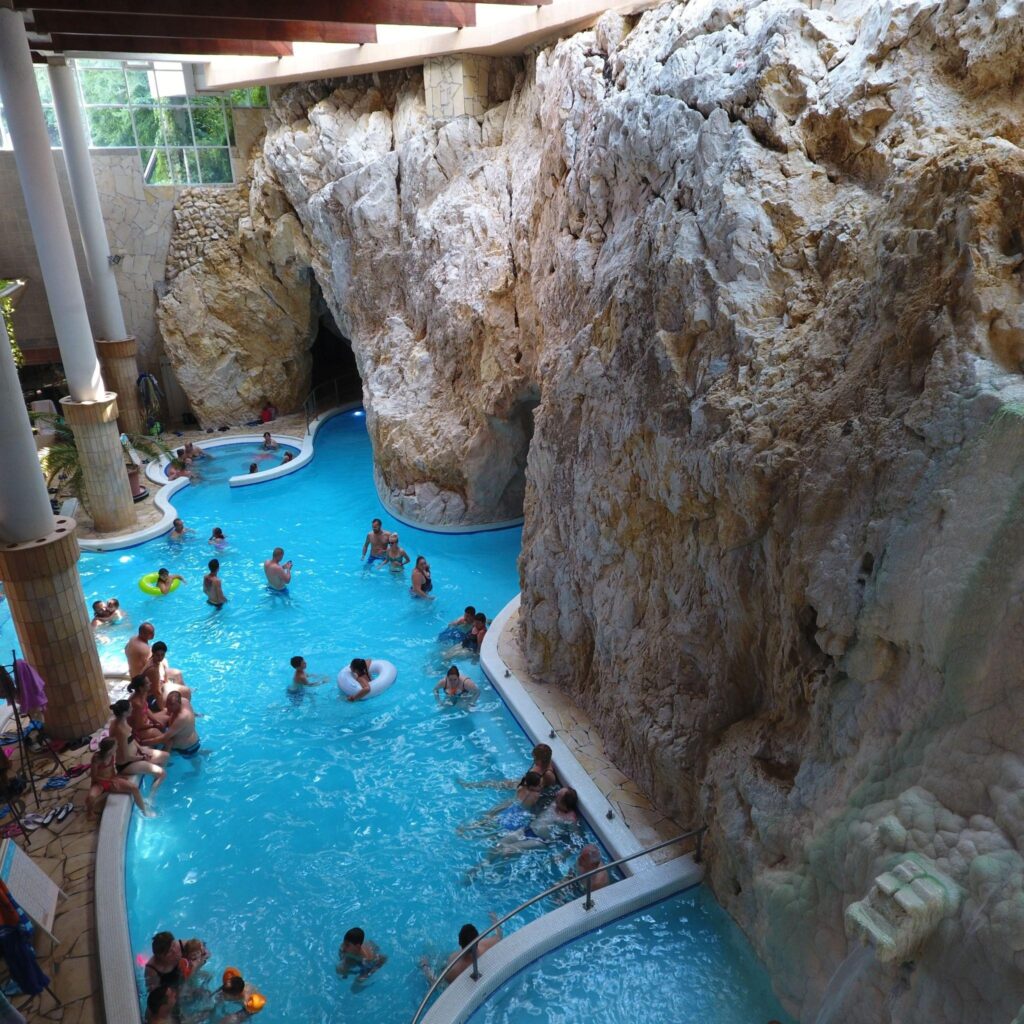
A thermal bath was already operating here in the 1920s, but in 1959, taking advantage of the area’s natural cave formations, a unique cave-bathing facility was opened. It has undergone several modernisations since then.
In 2024, it became unusable following a fire, and its renovation was completed only in 2026. It is now open to visitors again.
The story, however, is about more than the fate of a tourist attraction. It also highlights the vulnerability of destinations that build much of their tourism around a single major attraction. If the main attraction is out of operation for an extended period, the consequences are felt not only by the operator but also by nearby accommodation providers, restaurants and other tourism-related businesses.
Miskolctapolca today
Miskolctapolca remains an attractive destination for visitors. Those interested in city tourism and those who prefer hiking and nature can both find a variety of activities in the area. In addition to Miskolc’s attractions, Lillafüred, the Bükk Mountains and numerous hiking destinations are within easy reach.
And for those staying in the area for several days, neighbouring Slovakia is also close enough for a day trip. The historic centre and cultural attractions of Košice offer another range of experiences.
After fifty years, Miskolctapolca is still a tourist destination, but much around it has changed. The 1977 guide presents a developing resort where the Juno Hotel was one of the important modern accommodation options. Today, we see a district whose tourism assets remain, while part of its former infrastructure has become little more than a memory.
Perhaps that is precisely why it is interesting to look through the 1977 Panoráma travel guide again. It does not only tell us where people were advised to travel at the time. It also shows us what happened to these places during the nearly fifty years that followed.
By: Viktor Szentkiralyi