The Master and Margarita – Act Three
The title is, of course, a little misleading. As far as I know, there is no three-act version of the play.
A few weeks ago, I wrote about Mikhail Bulgakov’s (Russian novelist and playwright) novel The Master and Margarita, promising to report on the stage adaptations currently being performed at the National Theatre and the Katona József Theatre in Budapest.
There is a saying about biting off more than you can chew. Many projects begin with their creator quickly sketching out the basic framework. But when it comes to developing the details, it becomes clear how difficult it can be to fill that framework with meaningful and relevant content.
That is exactly what happened to me this time.
In my earlier introduction to the novel, I pointed out that adapting such a tightly structured yet multifaceted literary work for the stage must be extremely difficult. Nevertheless, I trusted in the creativity of the theatres and their artists.
I can say that I was not disappointed, but both adaptations surprised me. I wrote about the National Theatre production here.
My original plan was to conclude this series of articles by comparing the two performances.
But I had to admit that you cannot compare apples and pears. Of course, they have certain things in common: both are fruits and both belong to the pome fruit category. Beyond that, however, it is their differences that attract our attention.
The two theatrical productions therefore proved impossible to compare. Characters from Bulgakov’s book appeared on both stages, and the spirit of the novel was clearly present. Yet what we actually saw were two independent works of art, each of which could probably have inspired three more books.
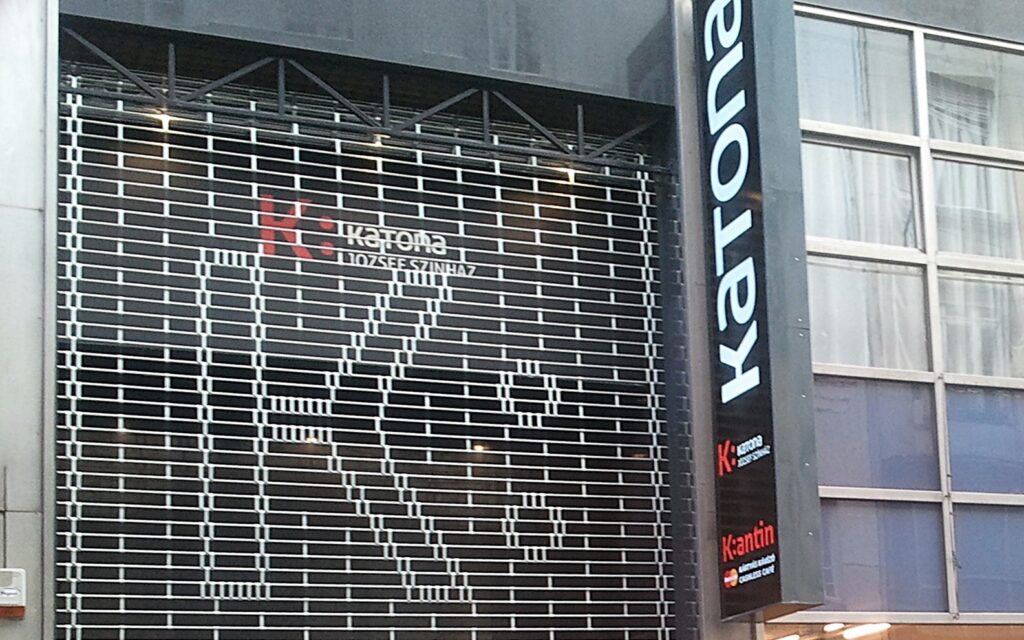
But let us return to the production at the Katona József Theatre. The adaptation was created by Viktor Bodó (Hungarian theatre director) together with the entire company.
Right at the beginning, the audience is told that knowing the original novel will not necessarily help them understand the performance. Yet, somewhat paradoxically, we are also informed that certain scenes cannot be fully understood without knowing the source material.
During the opening minutes, I found myself thinking back to my old literature classes, where, when analysing a work, we were expected to ask: What did the poet mean? The same question came to mind as I tried to focus on the story, the movements on stage and the sounds. Then another question emerged: What did Viktor Bodó, the director, have in mind?
At first, the whole thing seemed like chaos. The actors appeared to be wandering aimlessly across a completely empty stage. Occasionally, a narration or what felt like an excessively long monologue interrupted the monotonous, rather feeble movement.
Then, just as I was approaching that drowsy state before sleep, convinced that after a long time I might have to endure my first truly unwatchable performance, the auditorium suddenly exploded into action.
The journalists in the play rushed into the auditorium, moving past rows of seats and literally sweeping right in front of us. The director himself squeezed past me, repeatedly apologising. It was almost as if they knew exactly when an audience member might begin to lose interest because of the performance’s slow and cumbersome start.
This interlude literally shook me awake. Suddenly, I found myself inside the play. I had become part of it. I was sitting on the banks of the Moskva River, looking at the water. I saw Woland and his entourage moving through the streets, and perhaps, for a brief moment, I was even standing beside Pilate.
The performance continued. From time to time, the actors formed a chorus, sang songs and created different moods.
Almost all the actors wore grey suits and costumes. The whole thing reminded me of the black-suited scenes in the original The Matrix: it was as though the characters had truly stepped outside time.
I found it interesting that Woland did not seem particularly frightening for much of the performance. What I saw was a jovial old gentleman who exercised his power from the background, leaving the smaller tasks to the members of his entourage.
The dramaturgy gave the characters quite a lot of swear words to say. I found this somewhat artificial. Although expressions that would have been taboo a few decades ago are gradually becoming part of everyday speech, I found it uncomfortable to see emotions being manipulated in this way.
Woland only becomes truly frightening towards the end. When he sets Moscow on fire, smoke fills the auditorium as well. As the stage empties and disappears into the fog, Woland stands at its edge, watching the audience. The spectators are also gradually evacuated, supposedly because of a fire alarm, and the operation succeeds.
Woland, however, remains motionless in the smoke. Only his outline is visible, but the figure who had seemed almost insignificant until then now reveals the full extent of his power. He slowly turns around and disappears from view.
The auditorium is almost empty. Some of the audience are now standing in the corridor beside the rows of seats. Then the narrator appears and announces that they are now going to read everything that was left out of the book. He sits down and begins to read. I have the feeling that I am trapped here and may have to listen to the novel all night.
But slowly, the curtain comes down. We applaud, but there is none of the usual celebration, none of the extended bows by the actors.
And perhaps it could not have been otherwise. The inhabitants of a city that has burned down have more pressing concerns than bowing to strangers.
I slept on it. By the following morning, the performance had finally come together in my mind. I now know what Viktor Bodó and his company had in mind.
By: Viktor Szentkiralyi
English translation: Galatea – an LLM-based digital assistant.