The Master and Margarita at the National Theatre of Hungary
In our previous article, we explored Mikhail Bulgakov’s remarkably complex, multi-layered novel and mentioned that we would also be looking at its stage adaptations in Budapest.
The National Theatre of Hungary has also brought the play to its stage, in a distinctive interpretation by Macedonian director Aleksandar Popovski.
Numerous reviews of the production have been published, offering a good insight into the views of theatre professionals.
I am not a theatre insider, however. I simply enjoy the atmosphere of the theatre, particularly productions that depart from conventional approaches and offer audiences something new and daring.
The novel is a complex, multi-character story unfolding across several timelines. When I read it, I could not imagine how all this could be brought to the stage, with its limited space and time, without losing the work’s mystery and preserving the tension that captivates the reader.
Now I have received one possible answer to that question.
I have always thought that theatres should arrange their seating differently. Inspired by the theatres of antiquity, I would have liked to sit in the middle of the action, becoming part of the set or a silent extra, rather than watching the actors and the stage spectacle from the outside, perhaps from the back rows.
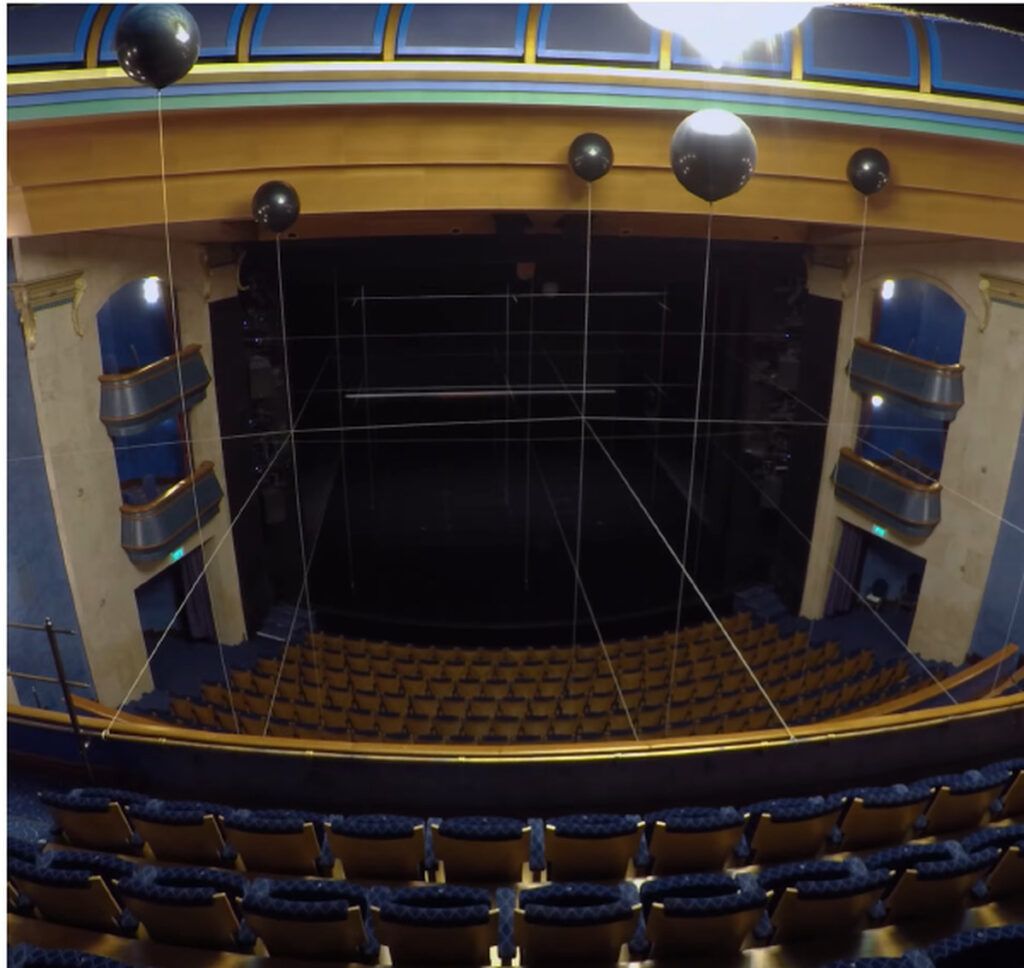
The framework of Aleksandar Popovski’s production is a grid formed by ropes. The director was not content to confine these ropes to the stage; he extended them across a substantial part of the auditorium as well. An old wish of mine was thus fulfilled: I was sitting inside the set, feeling that I, too, had become part of the performance.
The stage floor was glossy black, reflecting the action and creating another dimension, almost an underworld. For me, this intensified the already surreal world of the novel.
Within the grid, additional boundaries appeared from time to time, creating smaller, clearly defined playing areas. Almost instinctively, these spaces directed the audience’s attention towards individual scenes.
The lighting, with its interplay of light and shadow, further enhanced the intertwining of the story’s different timelines.
The director did not depart significantly from the novel’s content, and the dramaturgy preserved its essential ideas. At the same time, certain lines made it clear that we were in Budapest. This connected the timeline stretching from ancient Jerusalem, through Moscow in the 1930s, to Budapest today.
The story thus acquired a contemporary dimension while retaining its timeless quality. After all, it deals with questions that remain relevant today: power, fear, and the possibility of rising above them.
The interval is also an integral part of the theatre experience.
A coffee, a glass of champagne, a small cake, a chance to stretch after the first act. Perhaps a familiar face or two. A few words exchanged, and for a few minutes the anonymous mass of the audience disperses. We regain our individuality.
They say the interval matters to directors, too. This is when they watch how many people leave the theatre, and their mood supposedly depends on the numbers.
The interval during the National Theatre’s production of The Master and Margarita seemed unexpectedly long to me.
I waited for the continuation. I waited for the catharsis. I waited to find myself inside the set once again.
Then I wondered whether the director had somehow managed to expand time and space. Perhaps the wait felt so long because I wanted the experience to continue, because I wanted the world I had entered inside the theatre to remain more than a memory—to remain real, at least for a little while longer.
What made the experience complete was the way the rigid grid dissolved at the end of the play. The ropes seemed to tear open the fabric of time, arranging the story within a complex, spiderweb-like pattern. It was as though they were bringing everything we had witnessed to a close while preserving it for the memory.
By: Viktor Szentkiralyi
English translation: Galatea – an LLM-based digital assistant.