The Glue That Holds Society Together – Gábor Iványi Turns 75
We rarely write about daily events or anniversaries. This article is an exception. The reason will soon become clear.
In our previous article, we wrote about how changes in our society and growing loneliness may create long-term, potentially irreversible problems.
Now we ask a different question: do we have good examples to follow? Do we know people who have remained faithful to their principles throughout their lives, continuing to stand by their convictions even when those convictions were not accepted by the political establishment of the day?
When we look for such people in Hungary, we tend to think of historical figures such as Ferenc Deák (a leading Hungarian politician of the Reform Era in the nineteenth century), Lajos Kossuth (a leader of the 1848–49 Hungarian Revolution and War of Independence) and others. Yet if we look around us today, we can also find contemporaries who have spent their lives standing up for social justice and against the division of society, despite the constant struggle against misunderstanding and the prevailing doctrines of those in power.
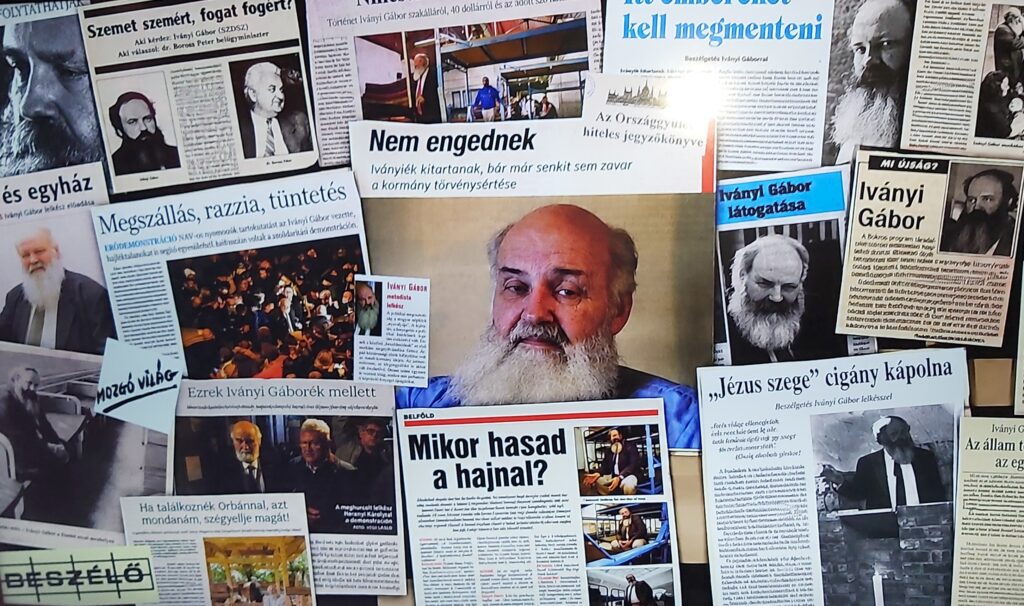
Gábor Iványi is a well-known name in Hungary. Unfortunately, in recent years, he has appeared in the headlines not primarily because of the selfless and wide-ranging social work of the charitable organisation he founded, but because of disputes over the legal status of his church and the continuing obstacles facing his work.
The press has covered these issues frequently and in considerable detail. That is not the subject of this article. Instead, I want to focus on the man himself: Gábor Iványi, a Methodist pastor who recently turned 75.
I had the privilege of attending a panel discussion where his friends and admirers could meet him in person and enjoy his company.
Based on what I knew of his life, I expected a man with a heavy heart to appear on stage. Instead, a cheerful patriarch with a playful look in his eyes arrived, telling colourful stories about his rich past and his sense of vocation.
Gábor Iványi first became more widely known in the 1970s. At that time, he took part, alongside other humanists, in establishing the Foundation for Supporting the Poor, known by its Hungarian acronym SZETA.
The 1970s were a period of state socialism in Hungary, and the official position was that poverty did not exist in the country.
During the discussion, Iványi explained that he had always fought for things to be called by their proper names. Poverty is what it appears to be; it should not be hidden behind an officially more acceptable expression such as “multiple disadvantage”.
In defiance of official policy, the foundation provided financial assistance to poor families, organised collections in various ways and stood up for people who, for one reason or another, had fallen outside the state welfare system, even under difficult circumstances.
Interestingly, after the political transition, the work of the Oltalom Charitable Association, founded by Iványi in 1989, and the Hungarian Evangelical Fellowship (MET), the church community with which he is associated, also attracted the attention of the “guardians” of the new order, which called itself a civic democracy. Perhaps this was because Iványi and his organisations did not simply repeat the official slogans, but responded to the reality around them. Their work challenged the notion that everything was fine in Hungary.
During the discussion, Iványi Gábor made another important point: when the state does not want to solve a problem, someone has to take responsibility for it.
Our social cohesion, and with it our society as a whole, is in trouble. Our individual and collective well-being seems to be slipping away. We need people who can set an example across political systems and social divisions, showing us that our fundamental values — solidarity, acceptance and the willingness to act — offer us a way forward. As members of a community, we can be not only people in need of protection, but also people who protect others.
Thank you, Gábor Iványi.
By: Viktor Szentkiralyi
English translation: Galatea – an LLM-based digital assistant.