Inota – When Industrial Heritage Finds a New Light
Every country has industrial sites that remain as traces of a bygone era. Once symbols of progress, they later lost their original function, and some have eventually found a new purpose.
Most of these sites are still inaccessible to the public. A few, however, have been given a new role and have returned to community life. In the case of the Inota Festival, “given a new light” is not merely a metaphor — it is literally true.
Located alongside Route 8, the Inota Thermal Power Plant was one of Hungary’s major industrial investments of the 1950s. At the height of its operation, the plant played an important role in the country’s electricity supply.
Its three enormous cooling towers still dominate the landscape. They are also connected to a technology in which Hungarian engineers László Heller and László Forgó played a decisive role. The international importance of the Heller–Forgó air-cooling system was demonstrated when the engineers received the Grand Prix at the 1958 Brussels World’s Fair.
The power plant no longer generates electricity. Its buildings and industrial structures, however, have found a new role.
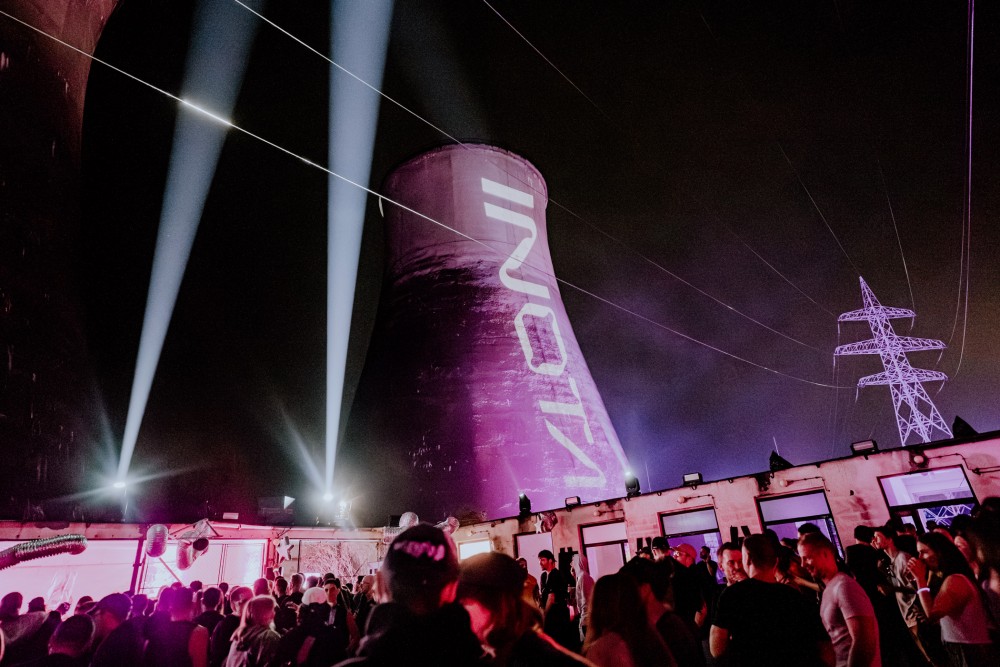
Every year, the Inota Festival fills the former industrial spaces with contemporary art and music. Its light installations create a remarkable connection between past and present: at night, the enormous industrial structures do not disappear into the darkness. Instead, light makes them visible again in an entirely new way.
The Turbine Hall, covering around 6,000 square metres and lined with glass bricks, once housed the turbines that generated electricity. Today, it serves as a monumental exhibition space and, at night, becomes a distinctive venue for contemporary electronic music.
Other parts of the former industrial complex have also become part of the festival. Pipes, stairways, mechanical structures and vast halls create a visual environment that would be almost impossible to reproduce with the scenery of a conventional festival.
This is precisely what makes the site special. The traces of its industrial past have not been hidden. Instead, the surviving elements of that past have become part of contemporary culture.
In 2026, the Inota Festival has expanded to a three-day programme. Its music programme brings together several radical branches of electronic music, while the area around the three cooling towers functions as a spectacular visual setting in its own right.
The Parts Warehouse provides space for smaller exhibitions and workshop programmes, while elsewhere on the site light, music and the former industrial environment come together to create a distinctive experience.
The story of the Inota power plant is therefore not simply the story of a closed industrial facility. It is an example of how the buildings of a bygone industrial era can acquire a new function without losing their original character.
The former power plant no longer produces energy. But it does produce another kind of energy: cultural energy.
Perhaps this offers one possible future for industrial heritage. Not every old factory needs to become a museum, and not every abandoned industrial site needs to be demolished. Some places remain truly alive when they are given a new purpose while preserving the memory of the era in which they were built.
At Inota, past and present do not simply stand side by side. They meet in a unique space shaped by light, music and steel structures.
By: Viktor Szentkiralyi