The Music Sweeps You Away
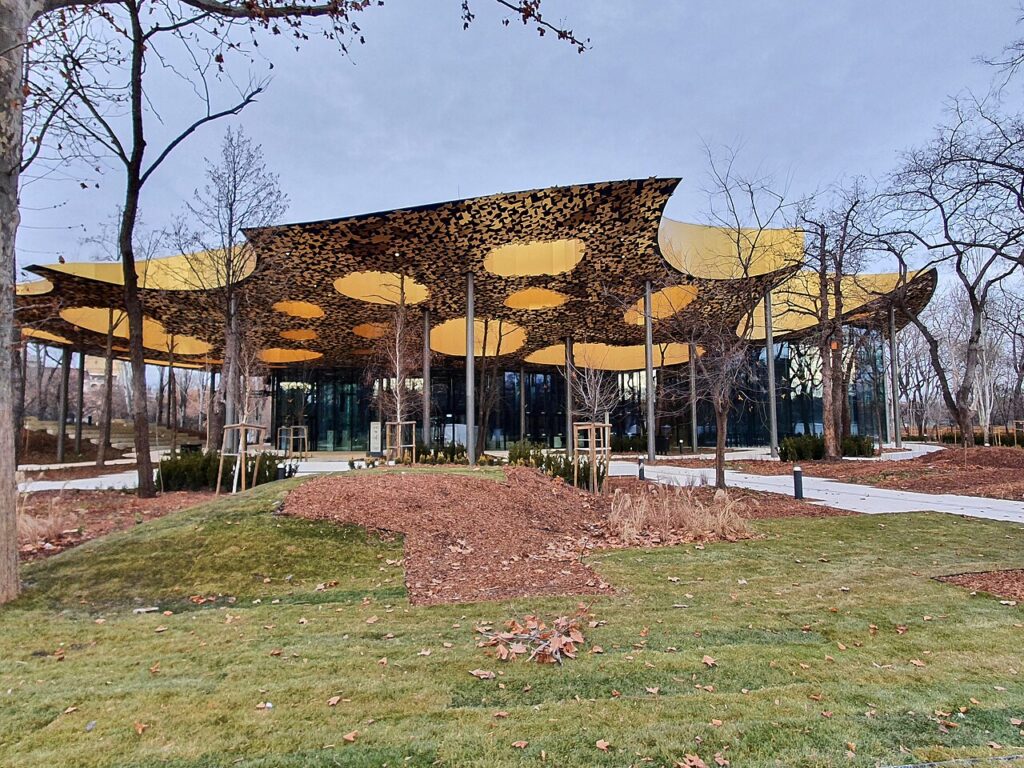
The world of Hungarian museums still often means static exhibitions presenting the past, frequently housed in buildings whose former beauty and elegance survive only in traces.
Budapest, however, is increasingly home to new institutions that are not simply exhibition spaces but cultural complexes adapted to the needs of the modern age. The House of Music Hungary, built in the City Park, is one such institution.
Seen from the outside, it creates a world of its own. Japanese architect Sou Fujimoto seems to have tried to make the building itself part of the park. It is almost open to its surroundings, less like a conventional building and more like a huge living organism.
Interestingly, this openness balances the enclosed character of the interior spaces. There has always been a debate about what the interior of a cultural institution should be like. Some consider architectural and interior-design excellence to be essential, while others believe that exhibitions and programmes should be what ultimately fill a building with life.
The House of Music Hungary follows the latter approach. The restaurant and the entrance hall still maintain a strong connection with the outside world, while the exhibition spaces and concert hall create a more enclosed universe.
And it is a remarkably diverse one. Mozart can be heard in the concert hall just as easily as songs by the Hungarian band Platon Karataev. Permanent and temporary exhibitions explore different periods of music and introduce influential musicians. In the Sound Dome, children can discover the world of sound, experiment with unusual instruments and devices, create noises and sounds, and even compose their own pieces.
For me, however, the most extraordinary attraction is the Sound Dome.
This immersive cinema offers a completely different kind of experience. A 360-degree panoramic projection fills the screen of the hemispherical dome, while an Ambisonic sound system using 40 independent sound sources surrounds the audience.
Visitors can even lie back on comfortable beanbags while taking in the images and sounds. The audiovisual works created specifically for the space can take us on journeys through landscapes or immerse us in details of works by Bosch and Csontváry.
Classical paintings seem to come alive across the dome. They dance, flow into one another, expand and contract. We can discover details in familiar paintings that might never catch our attention when standing in front of them in a conventional gallery.
When immersive works first appeared, I did not take them particularly seriously. I saw them as substitutes for museums, and perhaps even feared that traditional galleries might eventually be threatened by this new form.
I think differently now.
Just as television did not replace theatre, immersive art will not devour traditional galleries. We have to recognise that audiovisual culture has changed considerably over the past few decades, and immersive art has developed into a diverse and independent artistic field.
In an earlier article, I wrote about synaesthesia, in which several of our senses become involved in the act of experiencing art, creating a complex memory that is difficult to compare with anything else.
The Sound Dome offers something similar.
When the presentation ends, our eyes are still dazzled for a moment. The backs of older visitors may be slightly stiff after reclining on the beanbags, but at the same time we may find ourselves wanting to see those images once again.
If we have the chance, we can sit down on the terrace of the café upstairs. Suddenly we are back in nature, having coffee among the trees of the City Park. The experience of the Sound Dome slowly fades into the background, but something of it remains.
And before long, we are already wondering what the next production will be.
By:Viktor Szentkiralyi