Statues – How Our Environmental Culture Changes
When culture is mentioned, most people think of books, theatre or exhibitions.
Yet we tend to forget another part of our cultural environment: the monuments and statues we pass every day without even noticing them. I am not talking here about littering or the problems surrounding the use of public spaces, but about the historical objects that form part of the environment in which we live.
When these statues were erected, they responded to the social or political needs of their time. In earlier periods, many statues were funded through public donations. In recent decades, however, monuments have often been commissioned by political leaders, sometimes serving as monuments to their own era, ideas or political system.
On anniversaries, flowers or wreaths may occasionally appear in front of them, followed by a short ceremony. Then life goes on, and we once again forget the statue – and, more importantly, the person or event it was intended to commemorate.
Every country has its own way of dealing with monuments, which are also reflections of its historical and cultural development.
The expression “historical perspective” is not accidental. It takes distance and knowledge to give a contemporary meaning to a monument that was originally erected out of respect, enthusiasm or an educational intention.
The fate of monuments whose meaning has been reassessed varies around the world.
Some have not been removed, even though their historical significance has changed considerably. In Vienna, the Soviet War Memorial still stands on Schwarzenbergplatz. It was erected by the Soviet Army in 1945, after Soviet forces had captured Vienna.
Others have been reassessed but have nevertheless remained in place. Winston Churchill’s statue in London is a good example. The historical assessment of Churchill and the British Empire has changed considerably over recent decades, yet the statue remains where it was.
There are also monuments and statues that have disappeared from their original locations but have been brought together in a new and very different environment.
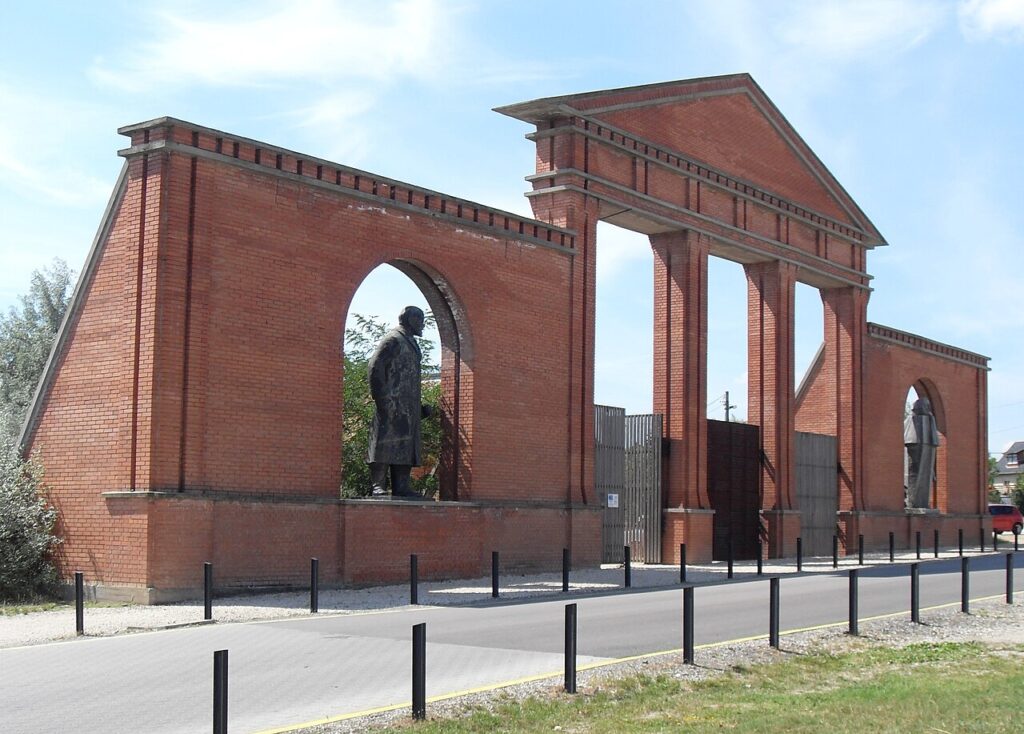
One such place is Memento Park in Budapest’s District XXII, where a number of statues erected between 1945 and 1989 and previously displayed in public spaces have been brought together.
The reason was the political transformation of 1989. Many statues that had carried political and ideological messages during the previous period, and which had often been regarded as almost untouchable, were removed from public spaces because the political system and the fundamental message they represented had lost their social legitimacy.
Memento Park can be reached from Route 7. A visit takes roughly an hour, making it a convenient stop for anyone travelling along Route 7 towards Lake Balaton or Lake Velence.
For me, the visit was particularly interesting because these statues had been an integral part of my surroundings during my childhood and young adulthood. Seeing them together in one place was a strange experience.
Ostapenko’s enormous statue once stood on Budaörsi Road, near the section where the M1 and M7 motorways leave Budapest. For years, “Let’s meet at Ostapenko” was an everyday expression in Budapest. The statue was therefore not only a political monument but also part of the city’s landscape and everyday life.
Memento Park is interesting not only because of its collection. It also creates a kind of retro atmosphere and evokes the spirit of the 1970s and 1980s. In the Hungarian collective memory, this period is remembered by many as a relatively peaceful and liveable era. Personal memory, of course, is not the same as the complete history of the period.
It is particularly interesting that the park also brings us face to face with urban legends.
Until 1956, a huge statue of Stalin stood on Budapest’s Parade Square. The bronze figure was about eight metres high and stood on a reinforced-concrete pedestal, making the entire monument roughly 25 metres tall.
The monument was more than simply a statue. The pedestal and the space in front of it also functioned as a stage for political events. Party and state leaders addressed the crowds from there and received the salute of participants in official parades.
The statue was pulled down during the 1956 Revolution, but the enormous bronze boots proved difficult to remove. Numerous urban legends later grew up around the story.
The statues displayed in Memento Park are originals. The boots and the platform installed opposite the park, however, are reconstructions.
It is worth looking at these works together and observing how artistic concepts, techniques and materials changed between the 1960s and the 1980s.
And remembering is important too. Our past remains with us, even when our assessment of the years in which these statues were created changes.
I do not know what the right solution is. But perhaps it is better to see these monuments together, in an environment where they can be examined and understood, than to see them melted down or left in a scrapyard.
Let us not forget: our world remains healthy when the past is not a burden, but a support for the future.
By: Viktor Szentkiralyi